
Đào tạo & nghiên cứu
Detection of Carbapenemase-producing Genes in the Acinetobacter baumannii Causing Infections Isolated in Vietnam by Using the Whole-genome Sequencing Technology
12 Tháng 06, 2026
217 Views
Detection of Carbapenemase-producing Genes in the Acinetobacter baumannii Causing Infections Isolated in Vietnam by Using the Whole -genome Sequencing Technology
Van Hung Pham1,2*, Huong Thien Pham1,2,3, Nhu Hong Thi Tran1,2, Thao Hanh Thi Nguyen1,2, Anh Hong Pham1,2,4
1Vietnam Research and Development Institute of Clinical Microbiology, Ho Chi Minh city 70000, Vietnam; 2NK-Biotek Co.; 3Pham Ngoc Thach University of Medicine,Ho Chi Minh city 70000, Vietnam; 4International University University, Vietnam National University, Ho Chi Minh City 70000, Vietnam
BACKGROUND
A. baumannii is a challenging pathogen due to its relatively high resistance rate to carbapenem antibiotics. Several different mechanisms contribute to A. baumannii‘s resistance to carbapenems, primarily through the production of carbapenemase[1,2]. Therefore, understanding the carbapenemase genes of A. baumannii is essential.
AIMS OF THE STUDY
To apply whole-genome sequencing technology to infectious A.baumannii strains isolated from hospitalized patients in Vietnam to detect carbapenemase-producing genes present in carbapenem-resistant bacterial strains.
MATERIALS AND METHODS
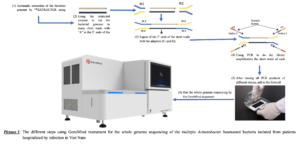
The 301 A. baumannii strains studied were recovered and purified, then lysed to recover all DNA, which was fragmented into segments no longer than 300 bp by using restricted enzymes. Next, the adapters were attached to both ends of these DNA fragments using ligase enzymes, followed by PCR amplification for attachment of the index sequences to both ends of the amplified DNA segments. Finally, whole-genome sequencing was performed using a GeneMind device from Shenzhen GeneMind Biosciences Co., Ltd. After sequencing, the obtained data were analyzed using many open-source software to detect the presence of bacterial carbapenemase-producing genes.
RESULTS
The results showed that all 228 meropenem-resistant A. baumannii strains had detectable carbapenemase-producing genes, including OXA23 (86.84%), OXA66 (77.19%), TEM-1 (67.98%); followed by NDM (14.47%), IMP-14 (2.63%), OXA500 (1.75%), OXA72 (0.88%); and the lowest were SHV-11, OXA417, OXA1045, OXA94, OXA217 and OXA317 with only 0.44% presence. In addition to genes producing carbapenemase that destroy carbapenems, the results also detected the A515V mutation in the ftsI gene at a very high rate (71.05%), which prevents carbapenems from binding to PBP3 to exert their effects. The different combinations of the carbapenem resistant genes were also detected with the highest ratio were ftsI_A515V+OXA23+OXA66+TEM-1 (61.40%); followed by ftsI_A515V+OXA23+OXA66 (7.89%), OXA23 (7.46%), NDM (6.14%), OXA23+OXA66+TEM-1 (5.70%), NDM+IMP (2.19%), and NDM+OXA23 (2.19%). then NDM+OXA500 (0.88%), ftsI_A515V+NDM+OXA23+OXA66 (0.88%); and the lowest ratio were NDM+IMP+OXA417 (0.44%), NDM+OXA1045 (0.44%), NDM+OXA94 (0.44%), NDM+SHV11 (0.44%), ftsI_A515V+NDM+OXA23+OXA500+OXA66+TEM1 (0.44%), ftsI_A515V+OXA66+TEM-1 (0.44%), OXA23+OXA72 (0.44%), OXA23+OXA66 (0.44%), OXA72+OXA317 (0.44%), OXA217 (0.44%), OXA930 (0.44%), and OXA500 (0.44%). These carbapenem resistant genes were not detected among 73 trains A. baumannii not meropenem resistant.
DISCUSSIONS AND CONCLUSION
Whole-genome sequencing technology has shown that 100% of carbapenem-resistant A. baumannii strains possess the carbapenemase-producing gene. This demonstrates that the mechanism of carbapenem resistance in the A. baumannii strains causing infections isolated in Vietnam is due to the bacteria producing carbapenemase that destroys carbapenem. The discovery of the genes and genotypes that enable A. baumannii to produce carbapenemase in this study provides essential data for testing sensitivity and specificity, as well as for developing technologies for rapid detection of carbapenemase-producing genes such as real-time PCR.
KEY WORDS
Carbapenem reisistant genes, Acinetobacter baumannii, NDM, IMP, OXA, ftsI_A515V

 |
REFERENCES
1. Adeyemi FM, Akinlade EA, et al. Carbapenem-resistance in Acinetobacter baumannii: prevalence, antibiotic resistance profile and carbapenemase genesin clinical and hospital environmental strains. BMC Infect Dis. 2025 Jun 2;25(1):786. doi: 10.1186/s12879-025-11169-x.
2. de Souza, J.; D’Espindula, et al. Carbapenem Resistance in A. baumannii: Mechanisms, Therapeutics, and Innovations. Microorganisms 2025, 13, 1501. https://doi.org/10.3390/microorganisms13071501
2. de Souza, J.; D’Espindula, et al. Carbapenem Resistance in A. baumannii: Mechanisms, Therapeutics, and Innovations. Microorganisms 2025, 13, 1501. https://doi.org/10.3390/microorganisms13071501
Tin liên quan
Liên kết


Địa chỉ: 793/ 58 Trần Xuân Soạn, phường Tân Hưng, Quận 7, TP. Hồ Chí Minh
Email:visinhlamsang.vcm@gmail.com
Sđt: 0903.698.920
Copyright 2024 Vietnam Research and Development Institute of Clinical Microbiology