
Đào tạo & nghiên cứu
Suitable Approach for Quality Assurance in the Identification of the Micro-organisms Including Bacteria, Viruses and Fungi
15 Tháng 06, 2026
214 Views
Suitable Approach for Quality Assurance in the Identification of the Micro-organisms Including Bacteria, Viruses and Fungi
Van Hung Pham1,2, Thao Hanh Thi Nguyen1,2, Huong Thien Pham1,2,3, Duy Khanh Tran1,2
1Vietnam Research and Development Institute of Clinical Microbiology, Ho Chi Minh city 70000, Vietnam; 2NK-Biotek Co.;
3Pham Ngoc Thach University of Medicine, Ho Chi Minh city 70000, Vietnam
BACKGROUND
Accurate identification of microorganisms detected in test samples is a crucial and necessary requirement. Classical methods are now rarely used because for bacteria, identification based on biochemical reactions via automated equipment such as VITEX®2 or gas chromatography via Maldi-tof is highly reliable. However, these solutions and equipments still have limitations in identifying rare bacterial agents; and especially fungal agents.
AIMS OF THE STUDY
This study evaluates the effectiveness of solutions implemented in accurately identifying bacterial and fungal agents isolated from test samples based on the detection and analysis of genetic structural differences between these agents. Furthermore, it also presents solutions for detecting agents that cannot be cultured, such as viruses and atypical bacteria, as well as the possibility of direct detection from test samples.
MATERIALS AND METHODS
The solutions with materials and methods currently applied by us for detection and identification of the bacteria, virus and fungi include: (1) Multiplex real-time PCR (MPL-rPCR) with real-time PCR devices and MPL-rPCR master mixes; (2) Sanger sequencing with the Sanger sequencer ABI3500 and related reagents; (3) Next-generation sequencing with the GeneMind next-generation sequencer and related reagents.
RESULTS
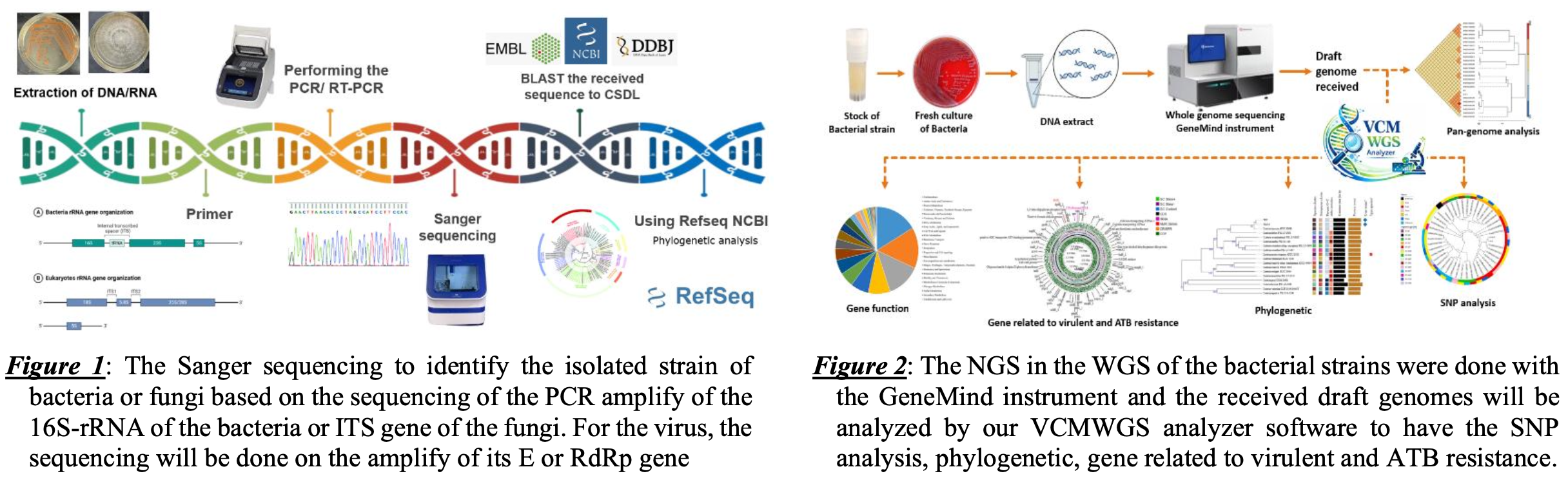
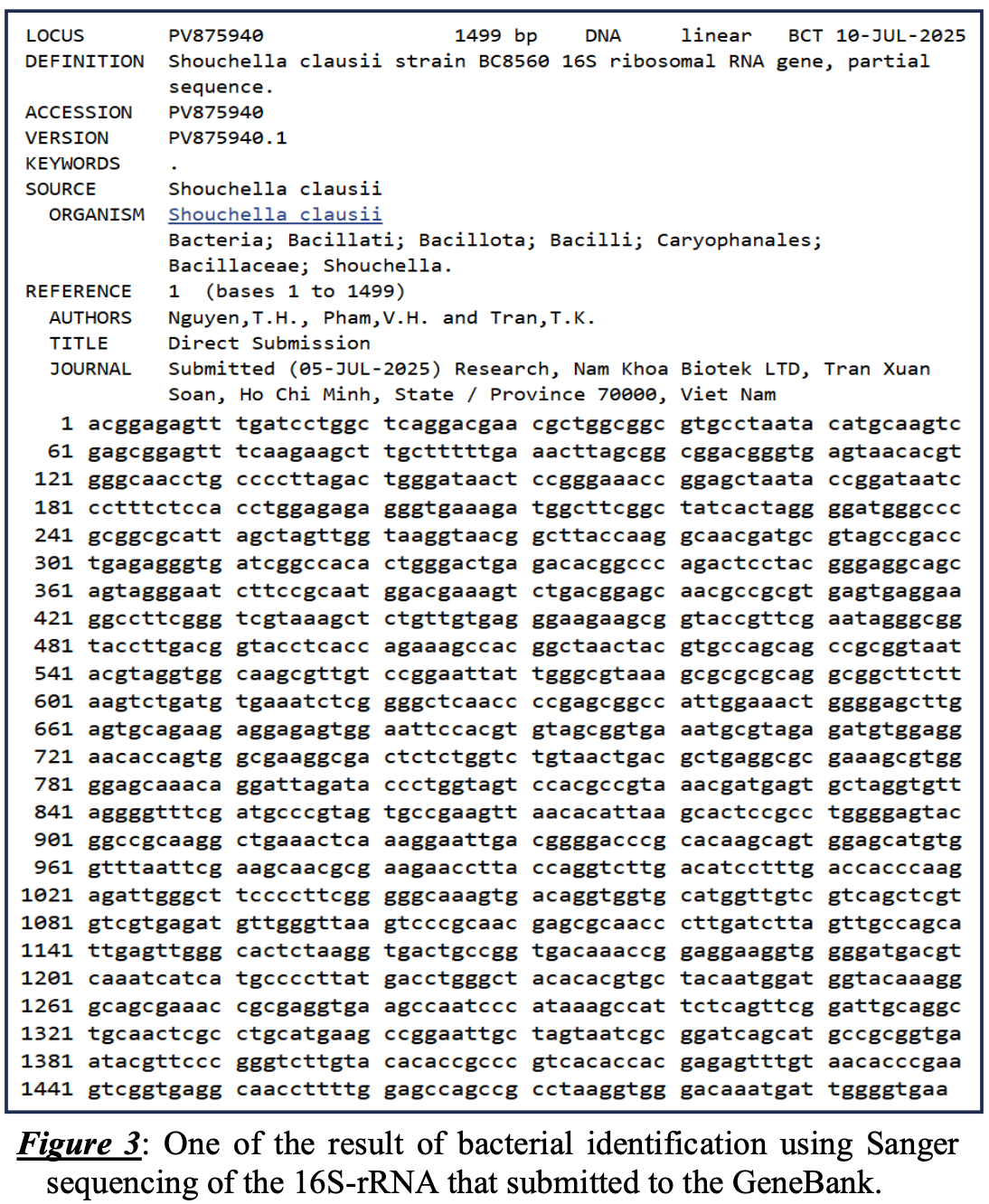
The effective methods we implemented were: (1) Sanger sequencing, targeting highly conserved gene regions such as the 16S-rRNA gene for bacteria[1], the ITS region for fungi, and specific coding regions (e.g., E or RdRp) for RNA viruses. (2) In cases requiring direct detection of bacterial, fungal, viral, and parasitic agents from test samples, we used MPL-rPCR (Multiplex real-time PCR) solution; this solution is currently used for rapid diagnosis of pathogenic microorganisms from various specimens taken from patients, however, it only detects agents for which we use specific primers and probes and cannot detect agents outside of the specific primers and probes used. (3) Currently, thanks to the new generation sequencing system through short-sequence sequencing, we have applied it to sequence the entire genome of isolated bacterial strains, including identification and detection of antibiotic resistance genes, and from there we have established software to analyze the collected data so that scientists can apply it[2,3]. (4) Metagenomic solution based on new generation sequencing technology for the presence of 16S-rRNA genes is also being used by us in detecting bacterial agents and their distribution in test samples, thereby assessing the abnormality of the microbiome in test samples. (5) In the near future, we will also try to deploy new generation sequencing technology in sequencing the entire genome of pathogenic viruses that we have detected such as RSV, Influenza A virus, SARS- CoV2…
KEY WORDS
Sanger sequencing; Next generation sequencing; Multiplex real-time PCR; 16S-rRNA; Whole genome sequencing.

DISCUSSIONS AND CONCLUSION
The integration of traditional sequencing techniques, next-generation sequencing, and MPL-rPCR technology, supported by rigorous internal and external quality control systems, has significantly enhanced the reliability, reproducibility, and international compatibility of the results for accurate detection and identification of microbial agents, including bacteria, viruses, and fungi. With these comprehensive methods, the results obtained so far have contributed to enabling healthcare providers to deliver timely and effective patient care, while also strengthening the overall effectiveness of infectious disease management.
REFERENCES
1. Chen L, Cai Y, Zhou G, Shi X, Su J, Chen G, Lin K. Rapid Sanger sequencing of the 16S rRNA gene for identification of some common pathogens. PLoS One. 2014 Feb 14;9(2):e88886. doi: 10.1371/journal.pone.0088886. PMID: 24551186; PMCID: PMC3925228.
2. Campodónico VL, Ruelle J, Fitzgerald A, Bergman Y, Osborne B, Bourdas D, Lu J, Carroll KC, Simner PJ. 2025. Evaluation of long-read 16S rRNA next-generation sequencing for identification of bacterial isolates in a clinical diagnostic laboratory. J Clin Microbiol 63:e01670-24
3. Costain G, Cohn RD, Scherer SW, Marshall CR. Genome sequencing as a diagnostic test. CMAJ. 2021 Oct 25;193(42):E1626-E1629. doi: 10.1503/cmaj.210549. PMID: 34697096; PMCID: PMC8562981.
2. Campodónico VL, Ruelle J, Fitzgerald A, Bergman Y, Osborne B, Bourdas D, Lu J, Carroll KC, Simner PJ. 2025. Evaluation of long-read 16S rRNA next-generation sequencing for identification of bacterial isolates in a clinical diagnostic laboratory. J Clin Microbiol 63:e01670-24
3. Costain G, Cohn RD, Scherer SW, Marshall CR. Genome sequencing as a diagnostic test. CMAJ. 2021 Oct 25;193(42):E1626-E1629. doi: 10.1503/cmaj.210549. PMID: 34697096; PMCID: PMC8562981.
Tin liên quan
Liên kết

Địa chỉ: 793/ 58 Trần Xuân Soạn, phường Tân Hưng, Quận 7, TP. Hồ Chí Minh
Email:visinhlamsang.vcm@gmail.com
Sđt: 0903.698.920
Copyright 2024 Vietnam Research and Development Institute of Clinical Microbiology